
Lucky: A Life Bought Back for 2,500 Pesos
He was meant for slaughter. Instead, he got a name, and a chance to live.
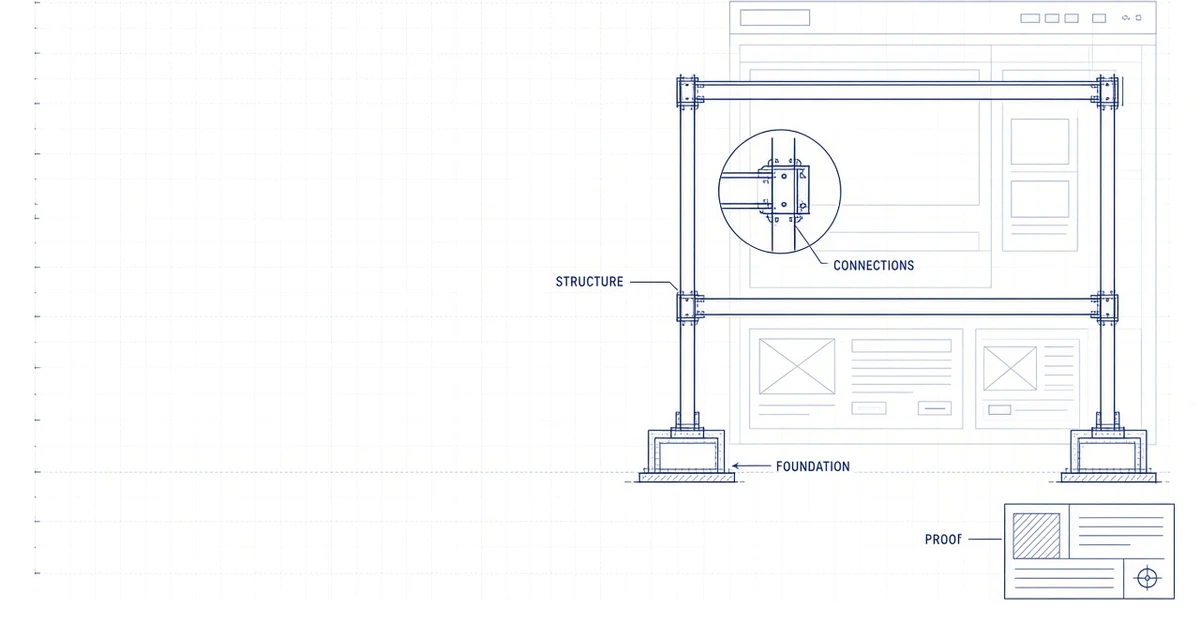
AI visibility is how easily AI assistants such as ChatGPT, Perplexity and Google's AI Overviews can find your website, understand what it says, and trust it enough to cite it in an answer. It is not a separate trick that replaces SEO. It is SEO done with more discipline: clear pages, consistent facts and visible proof, so a machine can trace every claim back to something solid.
Civil Engineer and Digital Operations Specialist Cha Javellana runs website, SEO and AI-visibility work at Lytt Digital and Net Real Estate. This guide explains what AI visibility means and gives you a four-layer check, borrowed from structural engineering, to run on your own site.
When someone asks an AI assistant a question, it often searches the web, reads a few pages and writes an answer, sometimes with source links. AI visibility is your chance of being one of those sources.
Traditional SEO asks, "Will this page rank for this search?" AI visibility asks harder questions:
A page can rank well and still be a poor source, because the answer is buried in paragraph six or the business details differ from page to page.
Less than the hype suggests. Google's own guidance on AI features and your website states that there are no additional requirements to appear in AI Overviews or AI Mode, and that you don't need new machine-readable files, AI text files or special schema to be included. A page simply has to be indexed and eligible to show in Search with a snippet.
OpenAI works in a similar way. Its crawler documentation explains that ChatGPT's search features rely on a crawler called OAI-SearchBot, and that sites blocking it won't be shown in ChatGPT search answers.
So Cha's position is simple: if someone sells you an "AI SEO" shortcut that skips the fundamentals, walk away. What AI changes is the standard of clarity. An assistant writing a two-sentence answer needs the facts stated plainly, in one place, with the source obvious.
The same applies to volume. A common assumption is that publishing more AI-written content will get a business cited more often. Cha takes the opposite view: every AI-assisted draft she works on gets a human review before it goes live, because an assistant will only quote what it can trust.
In structural design, every load has to travel along a continuous path, from the roof, through beams, connections and columns, down to the foundation. If one link is weak, the whole path fails, no matter how strong the rest is.
Cha trained in exactly this kind of thinking. She is a Civil Engineer with a BSCE and an MS in Civil Engineering (Structural), and started her career in structural steel design, including connection design. Websites fail AI assistants the way structures fail: rarely all at once, usually at one weak link. Here is the check, from the ground up.
Nothing else matters if crawlers can't get in.
Assistants extract passages, not whole pages. Make those passages easy to lift.
In steel structures, connections are where small mismatches turn into big problems. On a website, the connections are the facts that tie your pages and profiles together.
Mismatches like these show up on client websites too. The one Cha checks for most often is a business described one way in the page text and a different way in its meta description or schema. Her fix is to agree one approved description first, then bring the page text, meta description and schema into line with it.
An answer engine is choosing whose words to repeat. Give it reasons to trust yours.
Run a simple load test once a month:
AI answers vary, so treat the results as signals and look for patterns over months.
Cha starts every AI-visibility job the same way: before writing anything, she checks the foundations. Can the pages be crawled and indexed, and does Search Console show any problems? Next, she compares the core facts on the Home and About pages, the meta descriptions and the schema against one approved profile, and lists anything that doesn't match. What she deliberately doesn't chase is shortcuts: no special AI files, and no publishing volume for its own sake.
Content then follows a written brief of standing rules: how titles and roles are written, words to avoid, the voice for each page, and the rule that nothing goes live without a preview. AI helps with drafts and page changes, and an agent checks facts against the approved profile and flags anything it can't verify. A human then reviews and approves every AI-assisted draft. That review catches what AI drafting tends to miss: an outdated role, a claim with no proof, or wording that sounds right but isn't.
AI visibility is how likely AI assistants are to find your website, understand it and cite it when answering someone's question. It depends on whether crawlers can reach your pages, whether answers are easy to extract, whether your facts are consistent and whether there is evidence behind your claims.
No. Google states that you don't need new AI text files or special markup to appear in its AI features. An llms.txt file can be a tidy summary of your site for AI tools, and cha-javellana.com has one, but it is a nice extra rather than a foundation. A later article will cover it in detail.
Foundation fixes, such as unblocking a crawler or removing a stray noindex, can take effect once pages are recrawled, which can take days or longer. Building consistent facts and real authority takes months of steady, accurate publishing. Indexing and citation are never guaranteed by any search engine or assistant.
AI visibility rewards the same things good engineering does: a solid foundation, a clear structure, connections that agree, and proof you can point to. Skip the shortcuts and check your load path.
If you'd like a second pair of eyes on your website's structure, SEO or AI visibility, get in touch through the homepage or connect with Cha on LinkedIn.
About the author
Charmane Dawn (Cha) Javellana is a Civil Engineer and Digital Operations Specialist at Net Real Estate and Lytt Digital, where she leads website, SEO and AI-visibility work. As an AI Operations Lead, she designs and oversees teams of AI agents with clear hierarchies, role scopes, human approval points and documented workflows. She holds a BS and an MS in Civil Engineering (Structural), is an Autodesk Certified Instructor, and previously led Autodesk Construction Cloud implementations at CIM Technologies. Read more on her About page.
He was meant for slaughter. Instead, he got a name, and a chance to live.

Use the Eisenhower Matrix to prioritise your work, then delegate through SOPs, automations and AI agents with a human approving what matters.
AI visibility is how easily AI assistants such as ChatGPT, Perplexity and Google’s AI Overviews can find your website, understand what it says, and trust it enough to cite it in an answer. This guide explains the idea and gives a four-layer Load Path Check, borrowed from structural engineering, to run on your own site.
He was meant for slaughter. Instead, he got a name, and a chance to live.
Use the Eisenhower Matrix to prioritise your work, then delegate through SOPs, automations and AI agents with a human approving what matters.
Cha Javellana is a Civil Engineer and Digital Operations Specialist at Net Real Estate and Lytt Digital. As AI Operations Lead, she designs and oversees teams of AI agents with clear roles, guardrails and human approvals, and builds websites that search engines and AI assistants can understand and trust.

Websites, SEO and AI visibility, and digital operations built with structure, care and quality control.
© Cha Javellana 2025. All Rights Reserved.